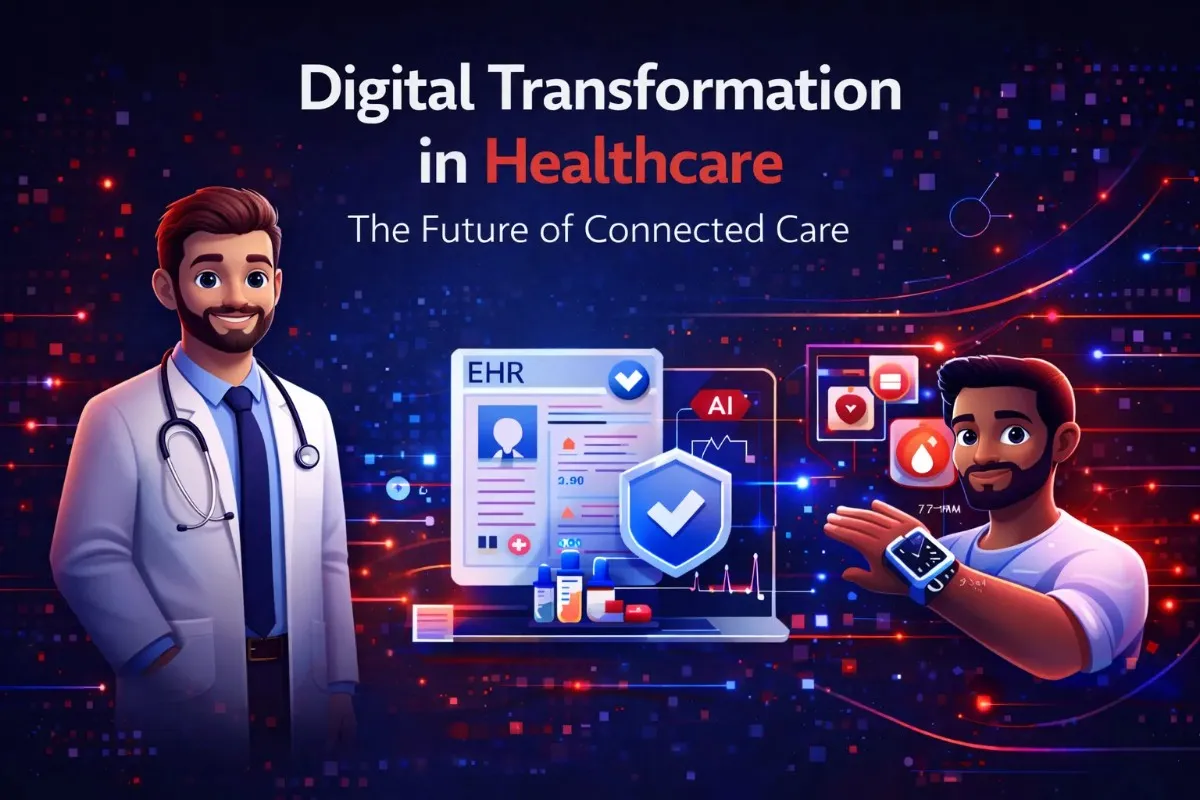
Meta Title: Digital Transformation in Healthcare 2026: The Ultimate Guide for Providers
Meta Description: Explore how Digital Healthcare Solutions and AI are redefining medical systems in 2026. Learn how Gaincafe Technologies helps hospitals lead the digital shift.
Focus Keyword: Digital Transformation in Healthcare
URL: /digital-transformation-in-healthcare
The healthcare landscape is no longer waiting for the future—it is living it. As we enter 2026, the global digital health market has surged to over $530 billion, fueled by a shift from reactive treatments to proactive, AI-driven wellness. For healthcare providers and technology partners like Gaincafe, staying ahead means moving beyond basic digitization toward a fully integrated, "virtual-first" ecosystem.
In this guide, we explore the core pillars of Healthcare Digital Transformation 2026 and how modern Digital Healthcare Solutions are redefining the patient-provider relationship.
Planning a healthcare digital transformation in 2026?
Tell us your current stack, compliance requirements, and workflow bottlenecks. We’ll recommend a practical roadmap: interoperability, cloud, automation, and AI—without disrupting care delivery.
What Is Digital Transformation in Healthcare?
Digital transformation in healthcare is the strategic integration of advanced technologies like Artificial Intelligence (AI), IoMT, and cloud computing into medical services. By 2026, it has evolved into a fully connected ecosystem that uses real time data to improve patient outcomes, streamline hospital operations, and enable personalized care models.
Core Pillars of Healthcare Digital Transformation 2026
To understand how Digital Healthcare Solutions are changing the industry, we must look at the specific areas where technology is making an impact.
Data Connectivity and Interoperability
The foundation of transformation is the ability to share data. In the past, medical records were stuck in silos. Today, the Future of Healthcare Technology relies on systems that talk to each other. This ensures that whether a patient is at a clinic or a major hospital, their data is available to the provider instantly.
Proactive Patient Monitoring
Through the Internet of Medical Things (IoMT), healthcare has moved from the hospital to the home. Wearable devices now track vital signs continuously, allowing for Digital Transformation in Healthcare to focus on prevention rather than just treatment. If a patient's heart rate or glucose levels shift, the system alerts the doctor automatically.
AI Driven Clinical Insights
Artificial Intelligence is now a core part of diagnostics. By analyzing thousands of medical images or patient records in seconds, AI helps doctors spot patterns that might be missed by the human eye. This leads to faster and more accurate results for patients.
Why 2026 Marks the Turning Point for Digital Healthcare
The year 2026 is officially the tipping point where technology is no longer an option but the core foundation of every medical practice. We have moved past the experimental phase. Today, Digital Transformation in Healthcare is the primary driver for hospital scalability and improved patient survival rates.
The Shift from Search to AI Driven Answers
One of the biggest reasons 2026 is so critical is the change in how patients find information. Most people now use AI engines to ask direct health questions. For providers, this means that having a strong digital footprint is essential to remain a trusted authority. Healthcare Digital Transformation 2026 is focused on making sure your medical expertise is "machine readable" so that AI models can cite your clinic as a top resource.
Real Time Data and Value Based Care
In 2026, the global healthcare market has fully embraced value based care. This model rewards doctors for keeping patients healthy rather than just treating them when they are sick. To succeed, clinics must use Digital Healthcare Solutions like remote monitoring and predictive analytics. These tools provide the real time data needed to track patient progress outside the hospital walls, making the entire system more efficient.
The Convergence of AI and Human Expertise
The Future of Healthcare Technology is defined by the seamless partnership between human doctors and Artificial Intelligence. By 2026, AI has become a standard tool for reducing administrative burnout. Whether it is automating clinical notes or sorting through complex lab results, digital tools are now handling the heavy lifting. This allows medical professionals to return to what they do best: spending quality time with their patients.
By adopting these changes now, healthcare organizations ensure they stay competitive in an era where digital speed and medical accuracy are equally important.
Still dealing with data silos and disconnected systems?
We unify your ecosystem using interoperability standards (FHIR/HL7), connecting EHR, labs, imaging, billing, and patient portals into one real-time patient record.
How Digital Healthcare Solutions are Optimizing Medical Systems?
Modern medical systems are no longer a collection of separate departments. Today, they are integrated digital ecosystems where technology handles the complexity, allowing humans to focus on care. Here is how Digital Transformation in Healthcare is structurally changing the industry:
- Centralized Data Intelligence In the past, patient records were scattered. Now, the Future of Healthcare Technology relies on unified cloud platforms that provide a 360 degree view of a patient’s health, ensuring every specialist has the same accurate information in real time.
- Automation of Clinical Workflows By implementing Digital Healthcare Solutions, hospitals are removing the burden of manual paperwork. Tasks like appointment booking, billing, and insurance verification are now automated, which significantly reduces clinician burnout and human error.
- Shift to Predictive Medicine Modern systems use AI to move from reactive to proactive care. Instead of just treating symptoms, Healthcare Digital Transformation 2026 uses predictive analytics to spot potential health risks early, often before the patient even feels unwell.
- Connected Patient Monitoring Through the Internet of Medical Things (IoMT), medical systems now extend beyond hospital walls. Continuous monitoring through wearables ensures that chronic conditions are managed in real time, reducing the need for emergency hospital visits.
- Enhanced Precision in Diagnostics Digital systems have introduced a new level of accuracy. High resolution imaging combined with AI analysis allows for faster and more precise diagnoses, which is critical for complex cases like oncology or cardiology.
What Are the Core Technologies Driving Digital Transformation in Healthcare?
In 2026, the foundation of modern medicine is built on a few powerful technologies. These aren't just tools; they are the engines making healthcare faster, safer, and smarter. When we talk about Digital Transformation in Healthcare, these specific pillars are doing the heavy lifting.
- Artificial Intelligence and Machine Learning AI is no longer just processing data; it is helping doctors make life saving decisions. In the landscape of Healthcare Digital Transformation 2026, Generative AI is being used to write clinical notes and predict patient risks before they even show symptoms. Machine Learning algorithms can now scan millions of records to find patterns that humans might miss.
- Internet of Medical Things (IoMT) The IoMT has essentially removed the walls of the hospital. Through wearable devices and smart sensors, a patient’s vital signs like heart rate and glucose levels are monitored in real time. This is a massive part of Digital Healthcare Solutions because it gives doctors live data, regardless of where the patient is located.
- Cloud Native Platforms Old physical servers are being replaced by cloud native architecture. The biggest advantage here is accessibility. Medical data can be reached securely from anywhere, and the system can scale up instantly without any downtime. At Gaincafe, we use cloud technology to make healthcare apps faster and more resilient.
- Blockchain for Data Security Medical records are highly sensitive. Blockchain technology ensures that these records are tamper proof. It creates a secure system where the patient has total control over who sees their data. This build of trust is essential for the Future of Healthcare Technology.
- Advanced Data Interoperability One of the biggest historical challenges in healthcare was different systems not being able to talk to each other. Now, thanks to standards like FHIR, different hospital apps and databases can share data smoothly. This connectivity is the true strength behind modern medical ecosystems.
- Augmented and Virtual Reality (AR and VR) AR and VR are changing the way surgeries are planned and how medical students are trained. Surgeons can now use virtual reality to practice complex procedures before ever stepping into an operating room. This significantly reduces the risk of errors during real surgeries.
Why Gaincafe Technologies Focuses on These Pillars
At Gaincafe, we don't just implement these technologies; we customize them to fit the specific needs of your facility. Our goal is to make sure your digital system is not just modern today, but ready for whatever the future brings.
Want to reduce clinician burnout with automation?
We automate scheduling, billing, verification, documentation support, and patient triage—so teams spend less time on admin and more time on care.
Key Areas of Digital Transformation in Healthcare Operations
Digital transformation is not just about patient care; it is about reinventing how a healthcare organization functions behind the scenes. By 2026, operational efficiency has become the backbone of successful medical institutions. When we look at Digital Transformation in Healthcare, these are the specific operational areas seeing the most significant impact.
- Optimizing Patient Journey and Experience Modern medical systems now use digital touchpoints to manage the entire patient lifecycle. From AI-driven appointment scheduling to automated check-ins and digital discharge summaries, every step is designed to reduce wait times. This focus on Digital Healthcare Solutions ensures that patients feel valued and informed throughout their care journey.
- Supply Chain and Inventory Management Hospitals deal with thousands of medical supplies every day. Automation and IoT sensors now track inventory in real time, ensuring that critical medicines and surgical tools are never out of stock. This level of digitalization prevents waste and ensures that life-saving resources are always available when needed.
- Revenue Cycle and Billing Automation One of the most complex parts of healthcare operations is billing and insurance claims. By using intelligent automation, hospitals can now process claims faster and with fewer errors. This shift in Healthcare Digital Transformation 2026 helps organizations maintain a healthy cash flow while reducing the administrative burden on their staff.
- Workforce Management and Resource Allocation Digital tools now help hospital administrators predict patient inflow. By analyzing historical data, the system can suggest how many doctors and nurses are needed for a specific shift. This ensures that the staff is not overworked and that every patient receives adequate attention.
- Facility and Asset Tracking Large hospitals often struggle to locate mobile medical equipment like ventilators or wheelchairs. Through the Internet of Medical Things (IoMT), these assets are now tagged and tracked digitally. This saves thousands of hours for the nursing staff, allowing them to focus more on clinical tasks rather than searching for equipment.
Strategic Operational Growth with Gaincafe Technologies
At Gaincafe, we understand that smooth operations lead to better care. We help healthcare providers build custom operational dashboards that bring all these data points into a single, easy-to-read interface. Our goal is to ensure that the Future of Healthcare Technology works for your staff, not against them.
Key Benefits: How Digital Healthcare Solutions are Saving Lives in 2026
The shift toward a digital ecosystem provides more than just modern convenience; it delivers measurable results for both the patient and the provider. By 2026, the success of Digital Transformation in Healthcare is measured by its ability to save time, reduce costs, and most importantly, save lives.
- Superior Patient Outcomes and Precision Care The most significant outcome of Healthcare Digital Transformation 2026 is the transition to precision medicine. With AI driven insights and real time data from IoMT devices, doctors can create personalized treatment plans that are far more effective than traditional approaches. This leads to faster recovery times and a marked decrease in diagnostic errors.
- Radical Operational Efficiency One of the core Digital Healthcare Solutions we focus on at Gaincafe is the automation of manual workflows. By digitizing billing, scheduling, and clinical documentation, healthcare facilities can reduce their administrative paperwork by up to 40%. This allows the medical staff to spend less time on screens and more time with their patients.
- Enhanced Patient Engagement and Accessibility Digital tools have made healthcare accessible from anywhere. Through high quality telemedicine platforms and on demand mobile apps, patients can consult with specialists without the need for travel. This not only improves patient satisfaction but also allows healthcare providers to extend their reach to rural and underserved populations.
- Data Driven Strategic Decision Making The Future of Healthcare Technology lies in the power of data. Modern digital systems collect vast amounts of information that can be analyzed to spot trends in patient health or hospital performance. These insights allow hospital administrators to make evidence based decisions regarding resource allocation, staffing, and long term business growth.
- Improved Security and Regulatory Compliance In an era where data privacy is paramount, digital transformation ensures that organizations remain compliant with strict regulations. By using secure cloud native environments and blockchain technology, medical facilities can protect sensitive patient information from cyber threats while ensuring it remains easily auditable.
Delivering Value with Gaincafe Technologies
At Gaincafe, we don't just build software; we build solutions that drive these specific outcomes. We work closely with healthcare leaders to ensure that every digital tool we implement results in a better experience for the patient and a more profitable, efficient operation for the provider.
Need a secure, compliance-ready healthcare platform?
We implement zero trust architecture, end-to-end encryption, and compliance-first design so you can scale digital care without increasing risk.
Overcoming Challenges and Risks in Healthcare Digitization for 2026
While the journey toward a fully digital ecosystem is rewarding, it is not without hurdles. To achieve a successful Digital Transformation in Healthcare, organizations must proactively address the technical and ethical risks that come with modernization.
Here are the primary obstacles healthcare leaders face in 2026:
Data Privacy and Cybersecurity Vulnerabilities
As medical systems become more connected, the risk of data breaches increases. Protecting sensitive patient information is the biggest challenge in Healthcare Digital Transformation 2026. Cybercriminals often target healthcare databases because of the high value of medical records. To mitigate this, hospitals must move beyond basic firewalls and adopt zero trust architectures and advanced encryption to stay compliant with global privacy laws.
Integration Barriers with Legacy Medical Systems
Many healthcare providers still rely on outdated infrastructure that was never designed to communicate with modern software. This lack of interoperability is a significant roadblock for Digital Healthcare Solutions. When old systems cannot "talk" to new AI tools or cloud platforms, it creates data silos. Overcoming this requires a strategic approach to Legacy Application Modernization Services, ensuring that the Future of Healthcare Technology can actually function within existing hospital frameworks.
The Healthcare Digital Skills Gap
Technology is only as good as the people who manage it. One of the quietest risks in digitization is the shortage of professionals who understand both clinical workflows and advanced IT. Without a team that is trained in managing AI agents or IoMT networks, even the most expensive digital tools can become a liability rather than an asset. Continuous training and partnering with expert technology firms are essential to bridge this gap.
Managing the High Costs of Implementation
The initial financial requirement for a full scale digital overhaul can be a deterrent for smaller clinics and hospitals. From purchasing IoMT hardware to migrating to cloud native environments, the costs of Digital Transformation in Healthcare can add up quickly. To plan your budget effectively, you can refer to our detailed guide on Healthcare App Development Cost for 2026. However, the risk lies in viewing this as an "expense" rather than an "investment."
Ethical Concerns and Algorithmic Bias in AI
As we rely more on Artificial Intelligence for diagnostics, ethical questions arise regarding transparency and bias. If an AI model is trained on limited data, it may produce biased results for certain patient demographics. Ensuring that the Future of Healthcare Technology remains fair and transparent is a major responsibility for developers and medical boards alike.
How Gaincafe Technologies Navigates These Risks
At Gaincafe, we don't just hand over a piece of software and walk away. We help our partners navigate these specific challenges by:
- Building Secure Backends: Using Laravel and cloud native security protocols to prevent breaches.
- Modernizing Legacy Code: Ensuring your old data integrates perfectly with new digital solutions.
- Providing Ongoing Support: Helping your staff adapt to new technologies so you get the maximum ROI from your transformation.
Stuck with legacy hospital systems that don’t integrate?
We modernize legacy apps, build secure data pipelines, and connect EHR + labs + billing + portals using FHIR/HL7—without downtime.
The Roadmap Ahead: Healthcare Technology Trends for 2026 and Beyond
As we move through 2026, the digital landscape is shifting from "experimental" to "autonomous." The next phase of Digital Transformation in Healthcare will be defined by systems that don't just store data but actively think and act on it.
Here is what the medical industry can expect as we look toward 2026 and the years to follow:
The Rise of Autonomous AI Agents
By late 2026, we will move past basic chatbots. The Future of Healthcare Technology lies in "Agentic AI"—autonomous systems that can coordinate care between different specialists, manage complex insurance authorizations, and even pre-screen patients before they arrive at the clinic. These agents will act as a digital twin to the administrative staff, allowing human workers to focus on high-touch patient needs.
Expansion of Digital Twin Technology
One of the most exciting Digital Healthcare Solutions on the horizon is the use of "Digital Twins." These are virtual replicas of a patient's biological system. Surgeons can use these models to simulate a complex surgery in a virtual environment before performing it on the actual patient. This trend is expected to significantly reduce surgical complications and improve recovery outcomes by 2027.
Hospital at Home and Decentralized Care
The hospital of the future may not be a building at all. With the evolution of Healthcare Digital Transformation 2026, we are seeing a massive move toward "Hospital at Home" models. Advanced IoMT sensors and high speed connectivity allow patients with chronic conditions to receive hospital grade monitoring and treatment from the comfort of their own bedrooms, drastically reducing the strain on physical hospital infrastructure.
Bio-Digital Integration and Advanced Wearables
Beyond smartwatches, the next wave of wearables will include "smart pills" and "bio-sensors" that are either ingested or implanted. These devices provide an even deeper level of data, such as tracking internal drug delivery or monitoring gut health in real time. This is the next frontier for Digital Transformation in Healthcare, where the line between technology and biology begins to blur.
Digital Healthcare in Action: Real World Use Cases for 2026
The true value of Digital Transformation in Healthcare is best seen through its application in clinical and administrative settings. These real world examples demonstrate how Digital Healthcare Solutions are solving age-old problems with modern technology.
1. AI Driven Early Cancer Detection
One of the most powerful applications of the Future of Healthcare Technology is in radiology. Hospitals are now using AI algorithms to scan thousands of MRI and CT images. By comparing these images against a global database of known cases, the AI can spot minute irregularities that might be invisible to the human eye.
- Outcome: Early detection rates for lung and breast cancers have improved by over 20%, significantly increasing survival rates.
2. Remote Post-Surgical Monitoring with IoMT
Previously, patients had to stay in the hospital for days after surgery just for observation. Today, through Healthcare Digital Transformation 2026, patients are sent home with wearable IoMT sensors. These devices track heart rate, oxygen levels, and temperature, sending live data back to the hospital’s dashboard.
- Outcome: Hospital readmissions have dropped because doctors can catch post-surgical infections or complications the moment they start.
3. Blockchain for Secure Clinical Trials
Pharmaceutical companies are using blockchain to manage the massive amounts of data generated during clinical trials. Because the data is stored in a decentralized, tamper-proof ledger, the integrity of the results is guaranteed.
- Outcome: This increases trust between researchers and regulators, speeding up the approval process for life-saving drugs.
4. Virtual Reality for Pain Management and Therapy
In 2026, VR is no longer just for gaming. It is a vital tool for physical therapy and chronic pain management. Patients recovering from strokes or nerve damage use VR headsets to perform guided exercises in an immersive environment.
- Outcome: Patients report higher engagement in their therapy sessions and a significant reduction in the need for opioid-based pain medications.
5. Automated Pharmacy and Prescription Management
Modern medical systems are integrating automated dispensing units that are synced with a patient’s EHR. When a doctor updates a prescription, the pharmacy system automatically verifies insurance, checks for drug-to-drug interactions, and readies the medication for pick-up or drone delivery.
- Outcome: This minimizes human error in medication dispensing, which is one of the leading causes of preventable medical complications.
The Gaincafe Edge: Accelerating Digital Transformation in Healthcare for 2026
At Gaincafe Technologies, we understand that technology in medicine is not just about code; it is about saving lives and improving the quality of care. Leading a digital overhaul requires more than just new tools—it requires a partner who can bridge the gap between complex IT infrastructure and clinical excellence.
Here is how Gaincafe helps healthcare organizations lead their Digital Transformation in Healthcare journey:
- Strategic Application Modernization Many hospitals are held back by old, slow legacy systems. We help you move beyond these limitations by migrating your infrastructure to secure, cloud native environments. Using frameworks like Laravel, we ensure your Digital Healthcare Solutions are fast, scalable, and ready to handle the data demands of 2026.
- Building Interoperable Medical Ecosystems Data silos are the enemy of good medicine. Gaincafe specializes in creating systems that talk to each other. We implement global standards like FHIR and HL7 to ensure that your lab results, imaging, and patient portals are perfectly synced, providing a 360 degree view of patient health.
- Developing Custom AI and Automation Workflows To combat clinician burnout, we build intelligent automation that handles the heavy lifting. From AI driven patient triage to automated billing and insurance verification, our solutions allow your medical staff to focus on patients instead of paperwork. This is a core part of Healthcare Digital Transformation 2026.
- User Centric UI and UX Design A tool is only useful if people can use it easily. Our design team focuses on creating intuitive interfaces for both doctors and patients. Whether it is a mobile app for on-demand consultations or a complex surgical dashboard, we prioritize accessibility and clarity to ensure high adoption rates.
- Security by Design and Compliance In the Future of Healthcare Technology, security is non-negotiable. Gaincafe implements zero trust architectures and end-to-end encryption to protect sensitive data. We ensure all our builds are fully compliant with HIPAA and other global privacy regulations, giving you and your patients total peace of mind.
Strategic Priorities for Healthcare Leaders to Dominate the 2026 Market
Staying ahead in 2026 requires more than just adopting new tools; it requires a fundamental shift in how care is delivered and managed. Organizations that fail to modernize their core operations will struggle with rising costs and patient dissatisfaction.
Here is what healthcare organizations must prioritize to remain leaders in the industry.
1. Automating the Administrative Burden
The biggest threat to modern healthcare is clinician burnout. Organizations must invest in intelligent systems that handle the heavy lifting of paperwork.
- Ambient Documentation: Use voice-to-text tools that automatically create clinical notes during patient visits, allowing doctors to focus entirely on the person in front of them.
- Smart Triage: Implement autonomous systems to handle appointment routing and pre-visit assessments, ensuring patients reach the right specialist faster.
2. Transitioning to a "Virtual First" Care Model
By 2026, physical hospital space should be reserved for emergencies and complex surgeries. Everything else should move closer to the patient.
- Hospital at Home: Use high-acuity remote monitoring to treat recovering patients in their own homes. This reduces hospital overhead and lowers the risk of facility-acquired infections.
- On Demand Access: Ensure that patients can access care, prescriptions, and lab results through a single digital touchpoint at any time.
3. Achieving True Data Interoperability
A patient’s medical journey is often fragmented because different systems don't talk to each other. Leading organizations are breaking these silos.
- Unified Patient Records: Ensure that data from labs, pharmacies, and specialists flows into a single, real-time health profile.
- Collaborative Networks: Build technical partnerships with other providers to ensure care is seamless, even when a patient moves between different facilities.
4. Investing in Predictive and Preventive Systems
The most successful organizations in 2026 are those that prevent illness before it happens.
- Early Warning Systems: Use data analytics to spot health trends and alert patients to potential risks like heart disease or diabetes months in advance.
- Resource Optimization: Use predictive tools to manage hospital staffing and inventory, ensuring you are never understaffed during peak health seasons.
5. Strengthening Cybersecurity and Patient Trust
As systems become more connected, protecting patient privacy becomes the foundation of your brand's reputation.
- Zero Trust Architecture: Implement security systems that verify every single data access request, ensuring that sensitive medical records are never compromised.
- Transparency: Be clear with patients about how their data is being used to improve their care, fostering a relationship built on trust.